- Automation
- Architecture
The Hidden Cost of Fragile Glue Code - Building Integrations That Fail Loudly
Silent automation failures are worse than manual work because nobody notices until a customer complains. Here is how we engineer durable workflows.
Anaya Sharma
Founder & Principal Engineer
· 5 min read
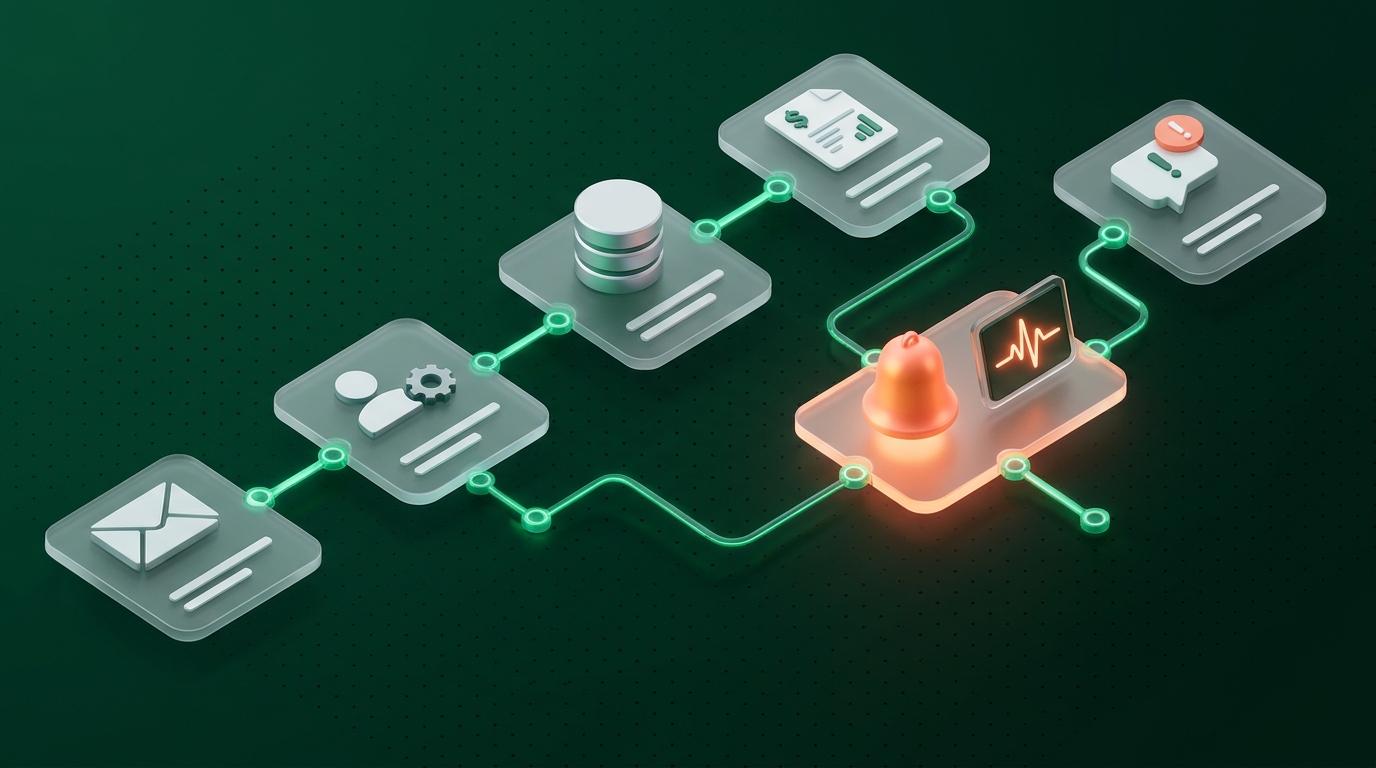
Most businesses start automating operations with quick point-to-point zaps and webhooks. Early on, that is completely sensible-you validate the workflow in hours instead of weeks.
The trouble starts six months later, when forty undocumented automations are quietly moving leads, invoices, and support tickets between your CRM, billing system, and project tracker. One upstream vendor renames a field, a token expires, and an automation stops running for eleven days before anyone notices.
Silent failure is the real enemy
Manual work is slow, but it is visible. An automation that fails silently is dangerous because the team assumes the machine handled it and stops checking.
Every integration we build-whether in n8n, a lightweight Cloudflare Worker, or a dedicated Node service-follows four non-negotiable rules:
- Validate payloads at the boundary. Never assume an external webhook will keep its exact shape forever. Parse incoming events against a strict schema so unexpected changes trigger an immediate alert instead of writing half-empty records into your database.
- Make every step idempotent. Networks retry. Webhooks fire twice. Use deterministic idempotency keys (like the source event ID or invoice number) so re-running a job never creates duplicate CRM deals, double-charges a customer, or spams an inbox.
- Separate retries from dead letters. Transient 502s and rate limits should retry automatically with backoff. Permanent errors (bad credentials, missing required fields, deleted target records) should land in a dead-letter queue and notify a human with the exact payload and failure reason.
- Keep deterministic logic out of LLMs. Use AI steps strictly where rules cannot work-classifying an unstructured email, extracting line items from a PDF, or drafting a summary. Keep routing, calculations, and state transitions in plain, testable code.
Knowing when to graduate from no-code to code
No-code workflow tools are great for low-volume, linear handoffs. Move a workflow into a small, version-controlled service when:
- Per-task SaaS pricing starts scaling faster than the value of the workflow.
- The logic requires branching, batching, or multi-system reconciliation.
- You need automated tests, git history, and staging environments before touching production data.
The payoff
When integrations are observable, idempotent, and loud about failures, teams actually trust them-and stop keeping shadow spreadsheets "just in case."